Designing a Unified Service Ecosystem at Enterprise Scale
Replacing 20 years of legacy debt with a unified platform for agents, dealers, and customers.
A global automotive leader faced a critical breaking point: their 20-year-old homegrown CRM had become too brittle to evolve.
Minor updates required months of development, and fragmented workflows were compromising their employee & customer experience.
Over a multi-year partnership, I served as the Lead Experience Architect to replace this legacy foundation with a unified ecosystem. Today, this platform powers millions of global customer interactions and stands as a benchmark for "One Team" delivery culture.

At a Glance
The Mission: Re-architect a 20-year-old legacy CRM into a unified service ecosystem for a global automotive leader.
The Challenge: Overcoming "The Build Trap" and a fragmented technical landscape that required advisors to use 12+ disconnected systems.
The Outcome: Successfully deployed CX Connect, resulting in a ≥75% improvement in case handling efficiency for 20,000+ users.
Outline
My Role
The Problem
The Approach
Insights > Actionable Design
What We Delivered
Impact
Reflection
My Role: Lead Experience Architect
I led the end-to-end experience architecture, partnering with agents, dealers, and engineering to re-architect 100+ essential workflows into a cohesive system.
Key Responsibilities:
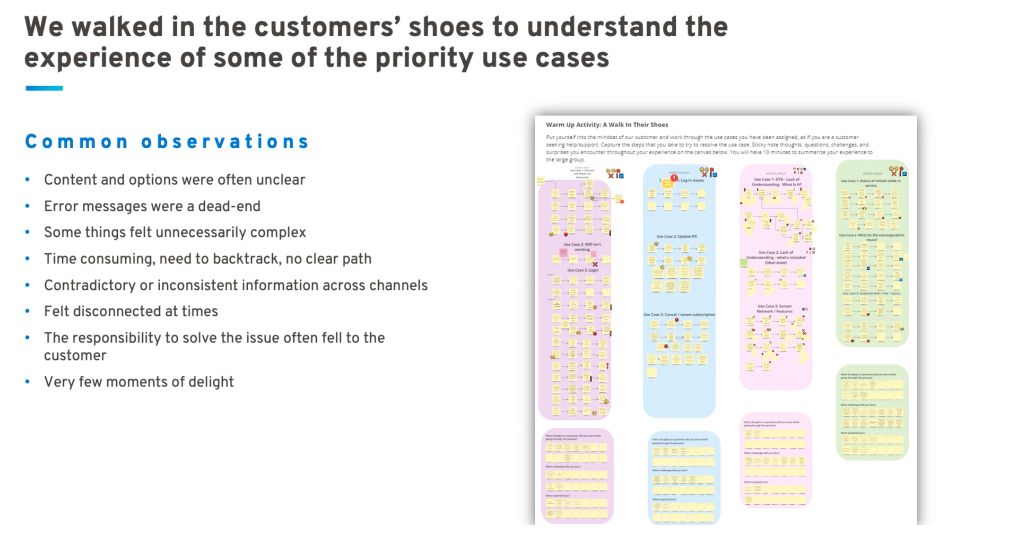
Research: Stakeholder interviews and call-center shadowing to uncover systemic friction.
Information Architecture: Translated complex service needs into streamlined workflows and a scalable data model.
UI/UX Design: Translating user flows and requirements into Visual Design and Interactive prototypes.
Strategic Oversight: Reduced ambiguity and maintained design direction across the platform
Problem: Trapped in the "Build Trap"
The organization was caught in the "Build Trap"—shipping incremental features and patches while failing to address the deeper structural problems preventing the system from working.
Symptoms:
Context Switching: Advisors navigated up to 12 disconnected systems to resolve a single issue.
Data Fragmentation: Critical customer, vehicle, and subscription data lived in silos, leading to inconsistent information and slowing down employees.
Technical Stagnation: Twenty years of technical debt made the system too brittle to support global scale or multi-language deployment.
Process Inconsistency: Service lines operated with different scripts and tools, even when customer needs overlapped.
The Approach
“It’s about hearing what sits underneath: uncertainty, frustration, desire to reassure, fear of losing trust. Observation reveals what people often can’t articulate in interviews. The best questions uncover intention and emotional goals, not just tasks.”
-
Observe and Listen.
26 interviews with stakeholder and advisor
20+ hours of live call shadowing in three call centers
Full audits of tools, systems, and CTI environments
-
Co-create.
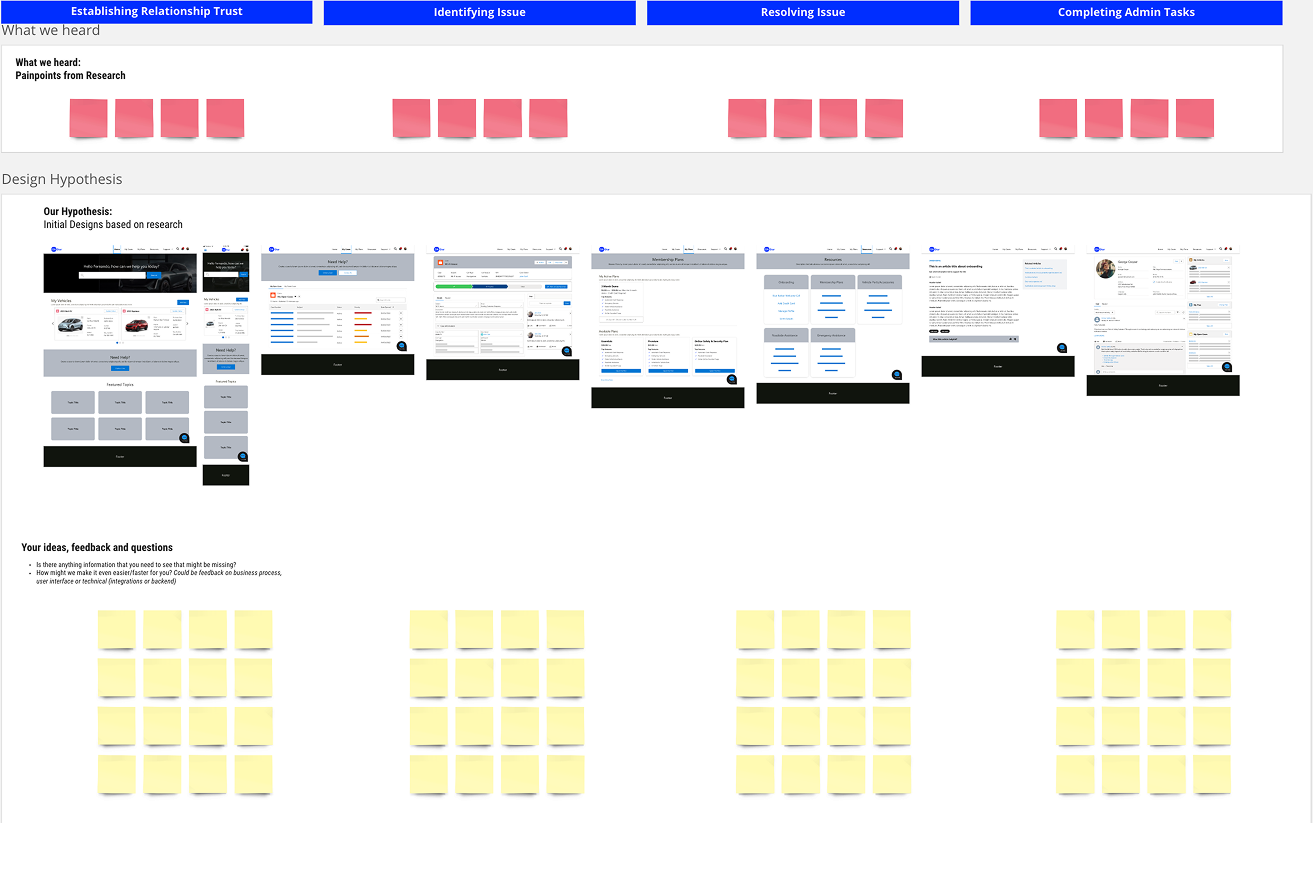
Workshops with supervisors, QA, KM, and training teams
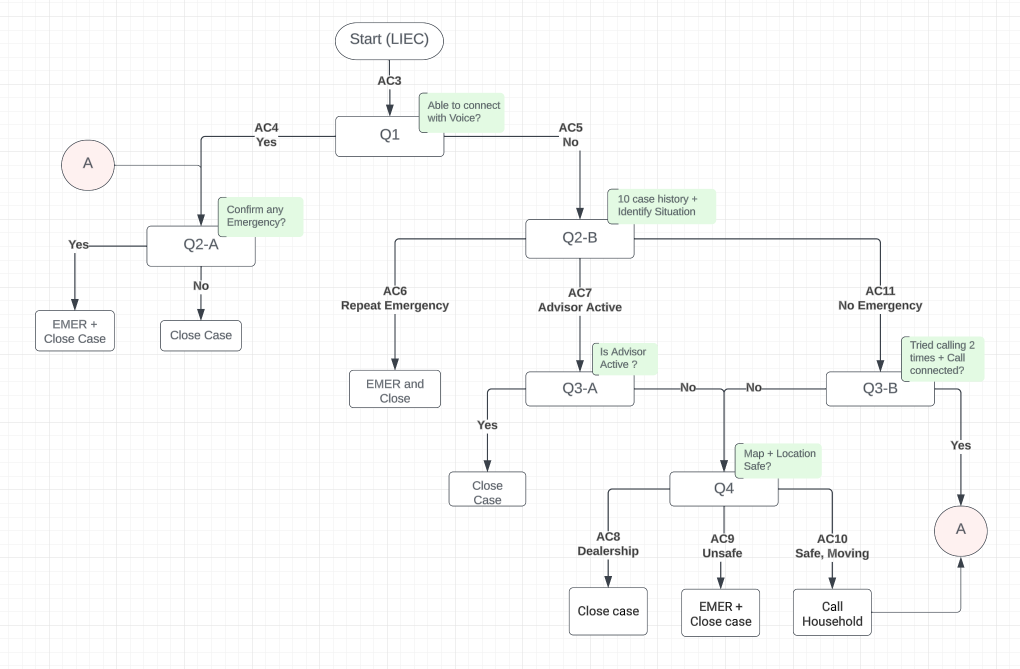
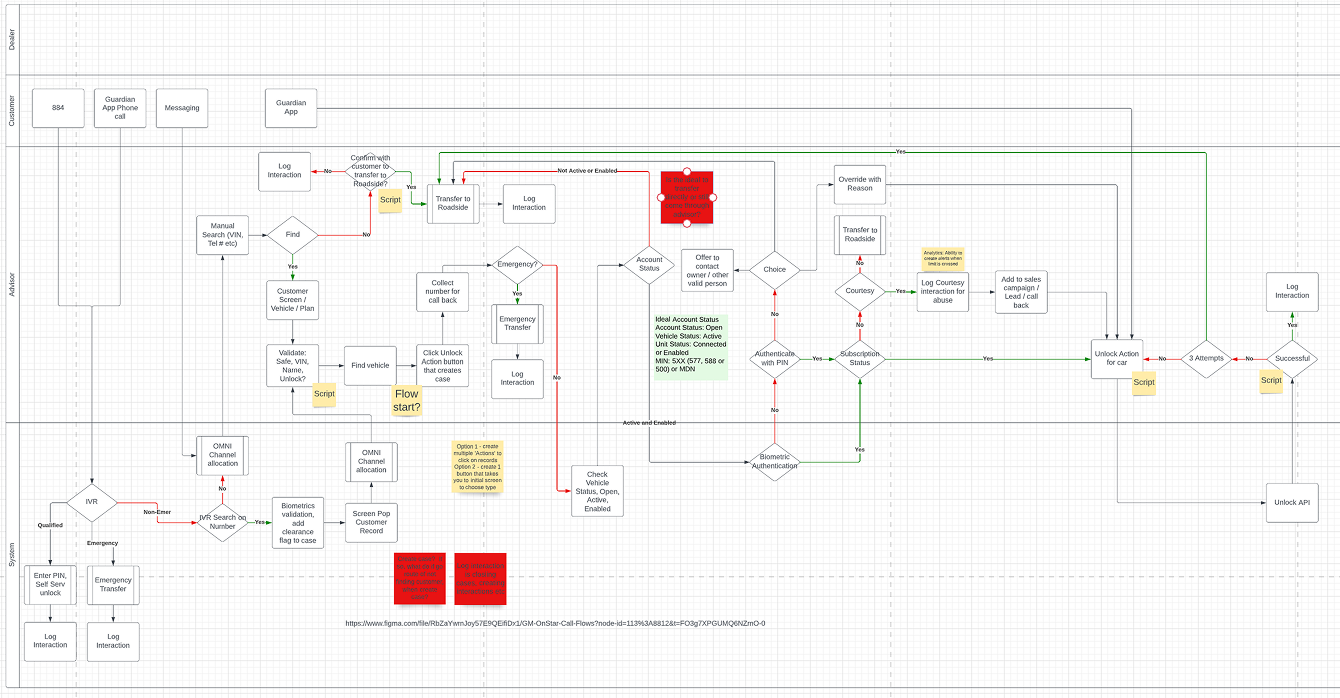
End-to-end experience mapping of 100+ workflows
Co-creation sessions with advisors and supervisors to design their dream experience
-
Validate.
Early prototypes validation through lightweight testing and quick iteration based on feedback
-
![]()
Deep Research
-
![]()
User Workflows
-
![]()
System Mapping
-
![]()
Co-creation workshops
-
![]()
Screen Flows
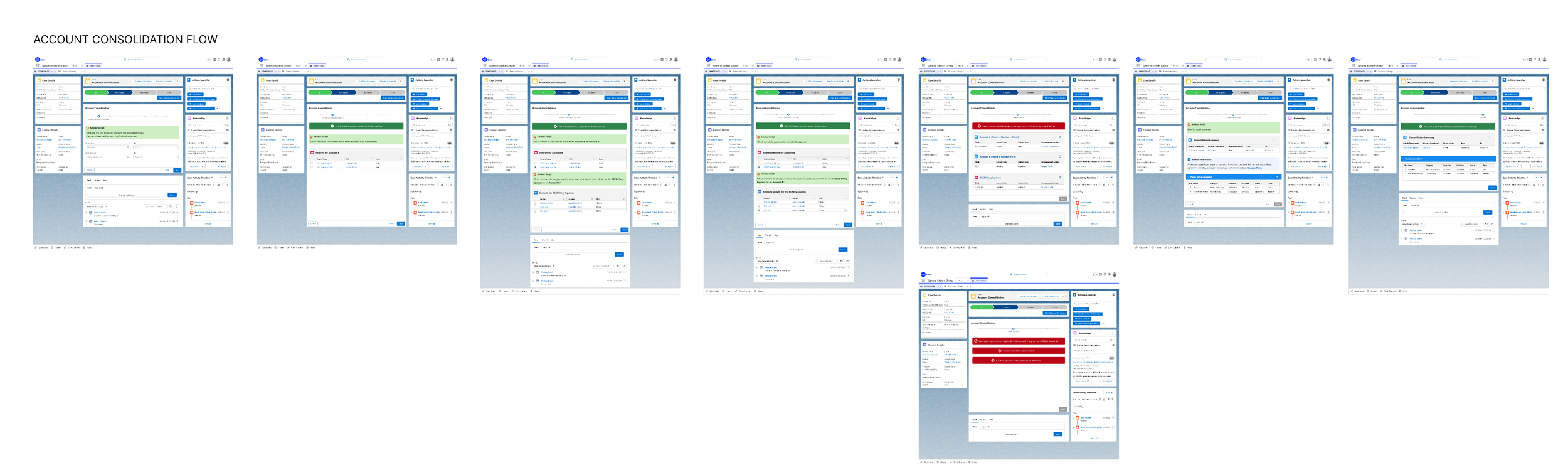
From Insights to Actionable Design
Discovery is only as valuable as the direction it provides. I translated our core research findings into
"How Might We" (HMW) statements, reframing systemic bottlenecks as strategic design opportunities.
The Full Picture Gap
"I have to open four tabs just to see if they have a warranty."
The Broken Hand-Off
"There is nothing worse than asking a customer to start their story over."
Workflow Friction
"I have to tell the customer 'hang on' while I jump into another system."
Dealer-Agent Silos
“Once a case goes to the dealer, it falls off the face of the earth."
Emergency Coordination
"When someone is panicking, I don’t have time to ask for their zip code."
How might we provide a quick customer/vehicle snapshot at call start to shift agents from data-gathering to problem-solving?
How might we architect a unified workspace so advisors always have shared context and interaction history?
How might we embed resolution tools directly into the workspace to maintain focus on the customer?
How might we bridge agent and dealer systems to provide real-time transparency and reduce anxiety?
How might we automate location, context and intelligence to prioritize life-saving support over manual input?
Design Principles
The unique thing about the “advisor’ experience is the pressure - when someone is live on the call, usually anxious impatient or even in an emergency, so we focused on these moments to ease the pressure.
We established a shared set of principles, based on the how we wanted to advisor to feel. These were aligned across product, operations, engineering, and design:
Design for these Moments:
Know Me — Use data to provide personalized, contextual experience. Avoid repetitive information gathering.
Empower Me — Support both self-service and advisor-led interactions with clear next steps and natural escalation paths.
Value My Time — Reduce steps, increase automation, and remove unnecessary friction.
Earn My Trust — Provide accurate, transparent information and set expectations clearly.
Bring Me Joy — Design interactions that are empathetic, intuitive, and easy to navigate.
What We Delivered
We designed and implemented a connected service platform that unified customer, vehicle, and advisor experiences. These six solution areas formed the core of the transformation and aligned the organization’s service model with our principles of Empower Me, Know Me, Value My Time, Earn My Trust, and Bring Me Joy.
Customer 360 — A single, unified view of customer identity, history, and interactions to reduce manual lookup and repetition.
Vehicle 360 — Connected vehicle diagnostics, service history, and coverage context to enable faster, more accurate resolution.
Advisor Homepage — A role-based starting hub that surfaced workload, follow-ups, and key actions with clarity.
Connected Service Workflows — Guided, standardized flows for high-stakes service scenarios, improving consistency and speed.
Dealer Portal — An external resolution experience that allowed dealers to initiate complex cases, track ownership, and receive closure.
Map & Location Services — Embedded real-time vehicle location and routing tools to support urgent and spatially-driven workflows.
Customer and Vehicle 360
Know Me. The Foundation of Personalization
Customer 360
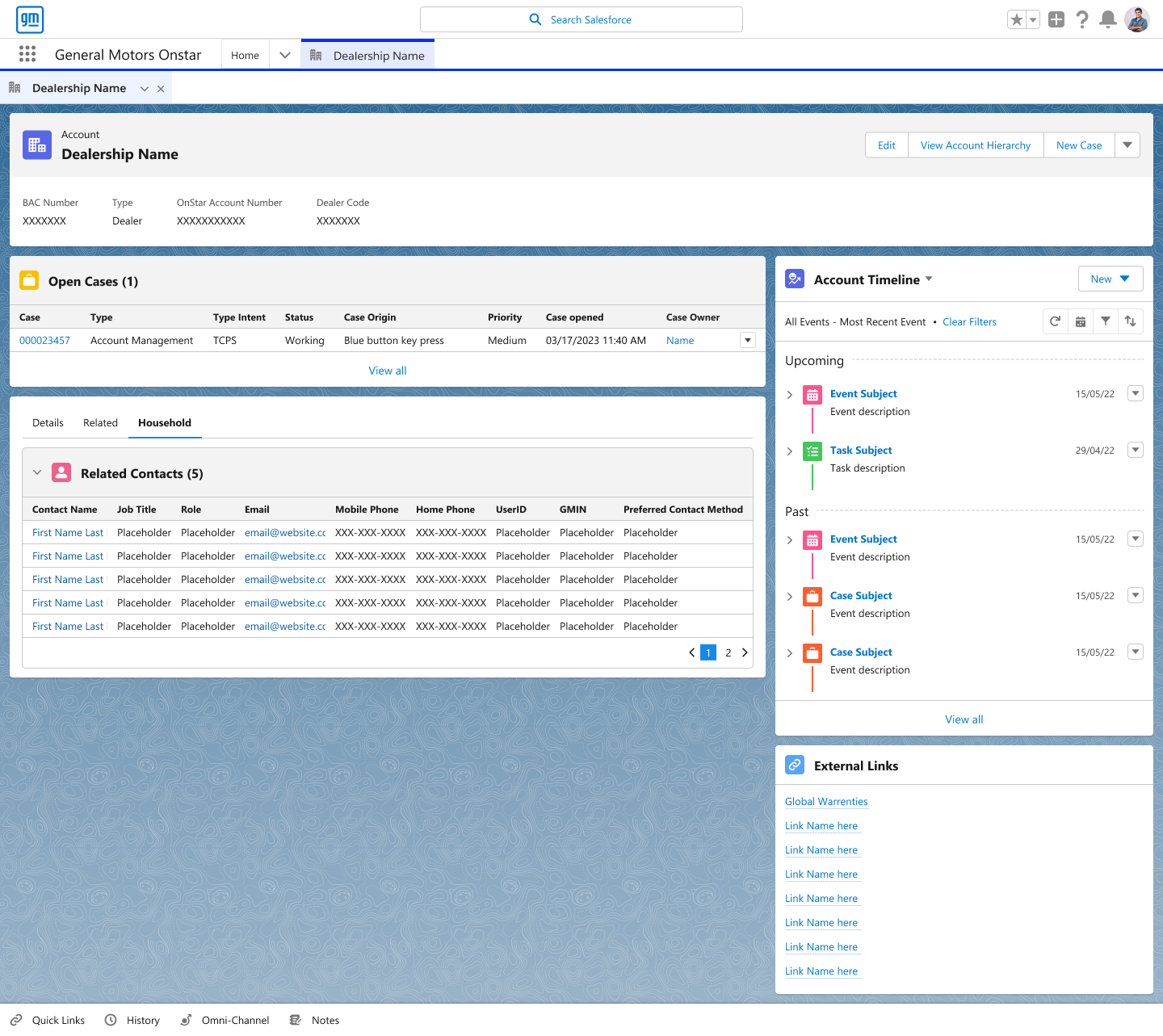
Strategic Value: We replaced fragmented data silos with a unified, real-time profile. This single source of truth aggregates vehicle telemetry, service history, and subscription status into a high-density, scannable header.
The Impact: Advisors no longer spend the first 90 seconds of a call digging for basic information. By surfacing the "360-view" instantly, we empowered agents to acknowledge the customer's history immediately, reducing average handle time (AHT).
We designed a vehicle 360 to support the customer 360. By synthesizing real-time telemetry, warranty data, and service history into a single, instantly understandable view, we moved the needle from fragmented data to "connected intelligence." This visibility allows advisors to focus on the human relationship rather than navigating legacy databases.
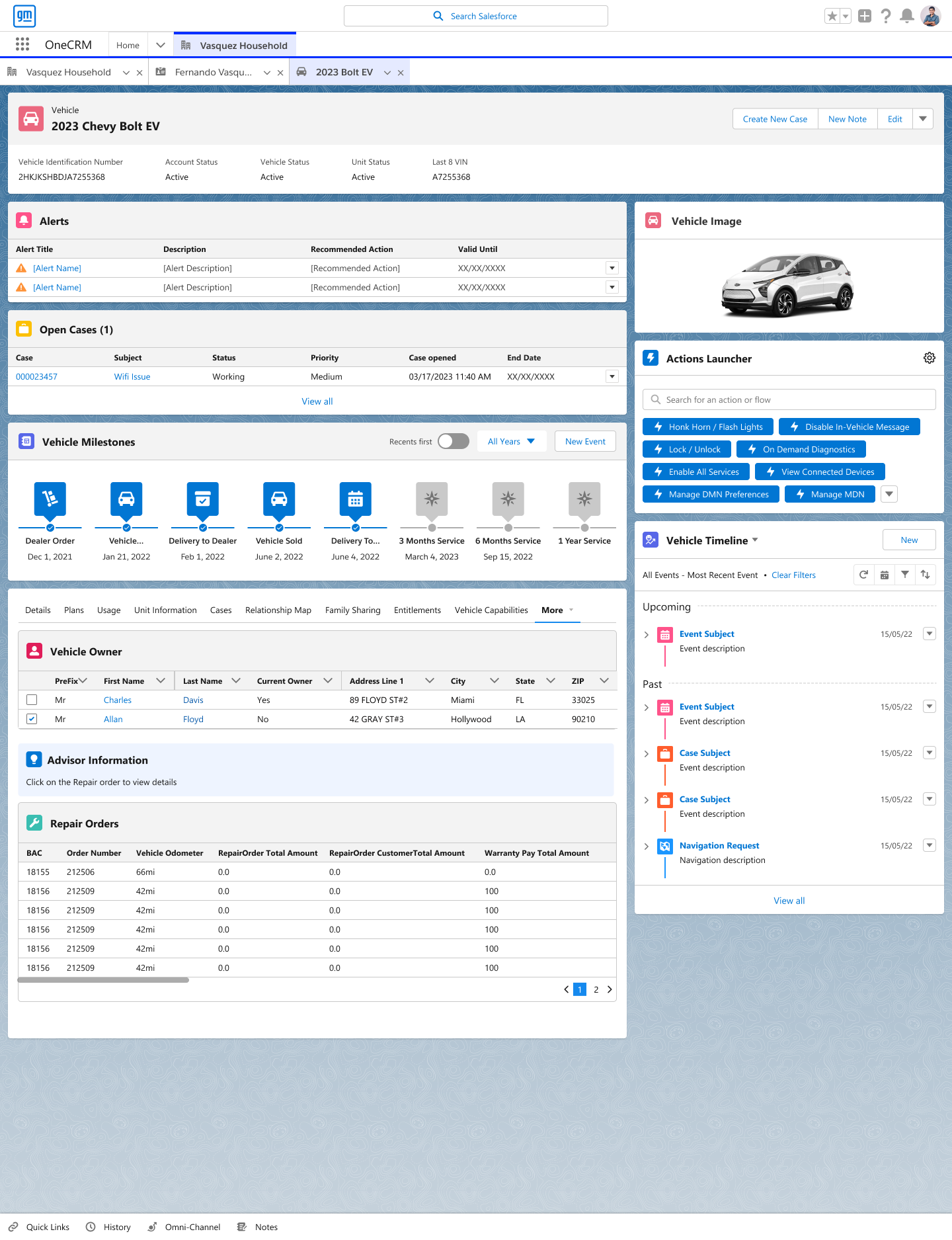
Vehicle 360
CASE 360
Earn My Trust. Transparency & Continuity
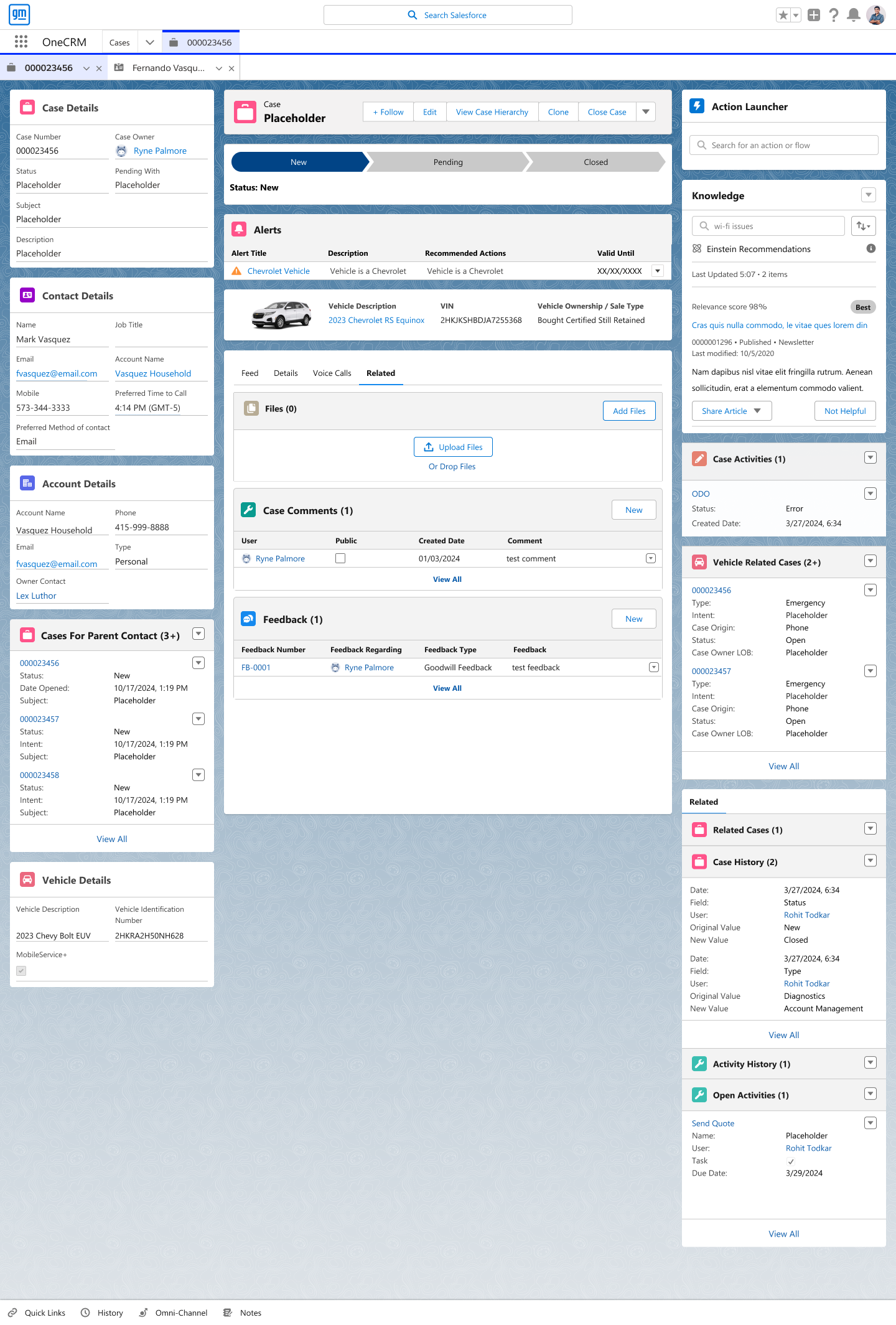
A Unified Interaction Workspace to bridge the gap between siloed data and active problem-solving. By consolidating disparate communication channels and resolution tools into a single, chronological interface, I eliminated the "Alt-Tab Tax." This solution transforms the case record into a living narrative that keeps the advisor in the flow and the customer at the center.
Strategic Value: A unified interaction workspace that consolidates disparate communication channels into a single, chronological interface.
The Impact: Eliminated the "Broken Hand-off" by providing a living narrative where the customer never has to repeat their story.
Embedded Guided Workflows in Cases
Value My Time. Embedded Workflows
Strategic Value: We embedded resolution tools directly within the workspace to eliminate the "Alt-Tab Tax."
The Impact: Resolution tools live where the work happens, allowing agents to stay "present" with customers while executing complex tasks.
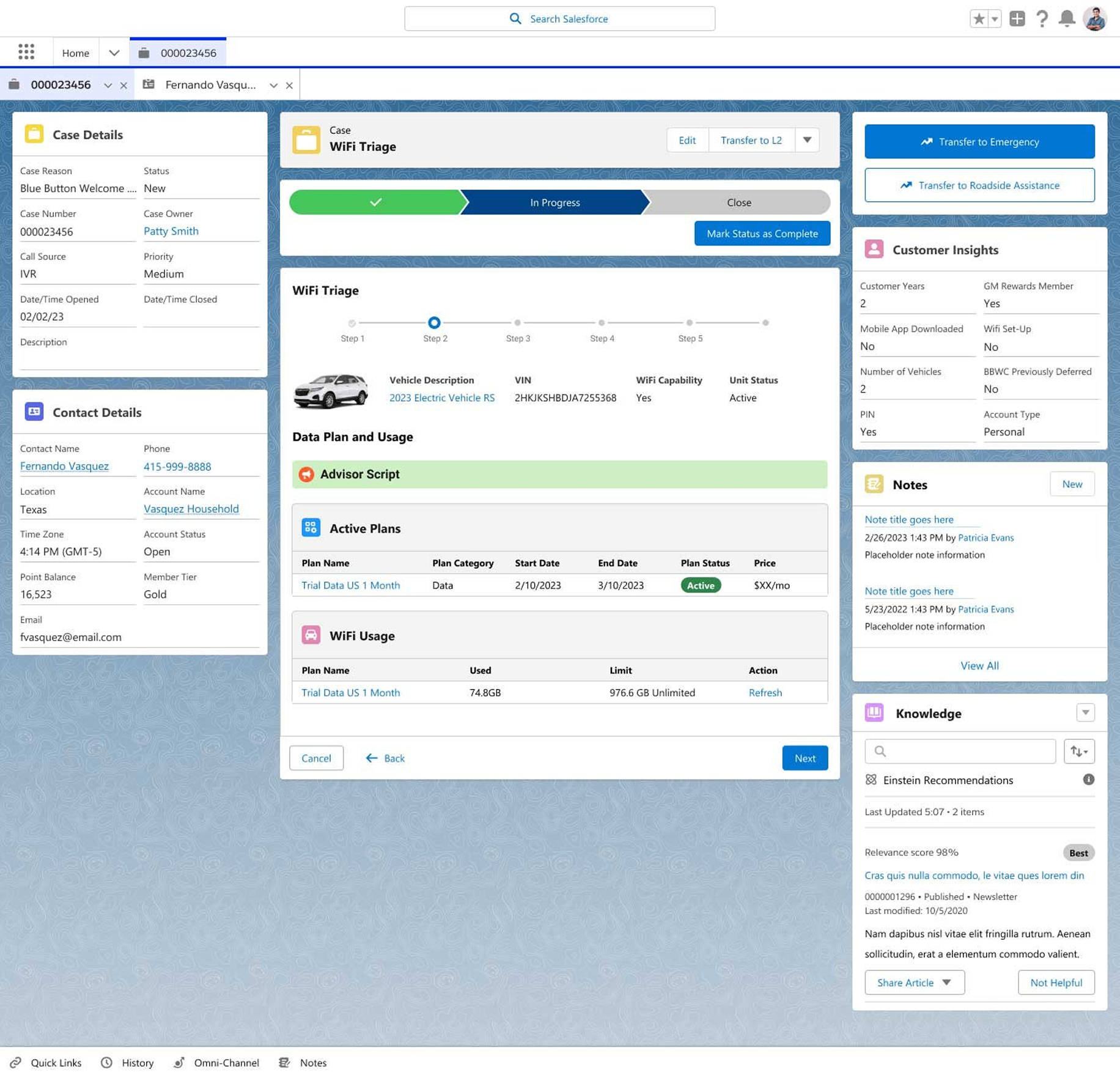
We embedded Guided Workflows that live directly within the case workspace, allowing advisors to trigger standardized resolution paths without losing their place. By embedding scripts, disclosures, and escalation logic into the active UI, I replaced improvisation with governed precision. This integration ensures that even the most complex, high-risk scenarios feel navigable and compliant, bringing structure to the conversation without having to leave the case or lose context.
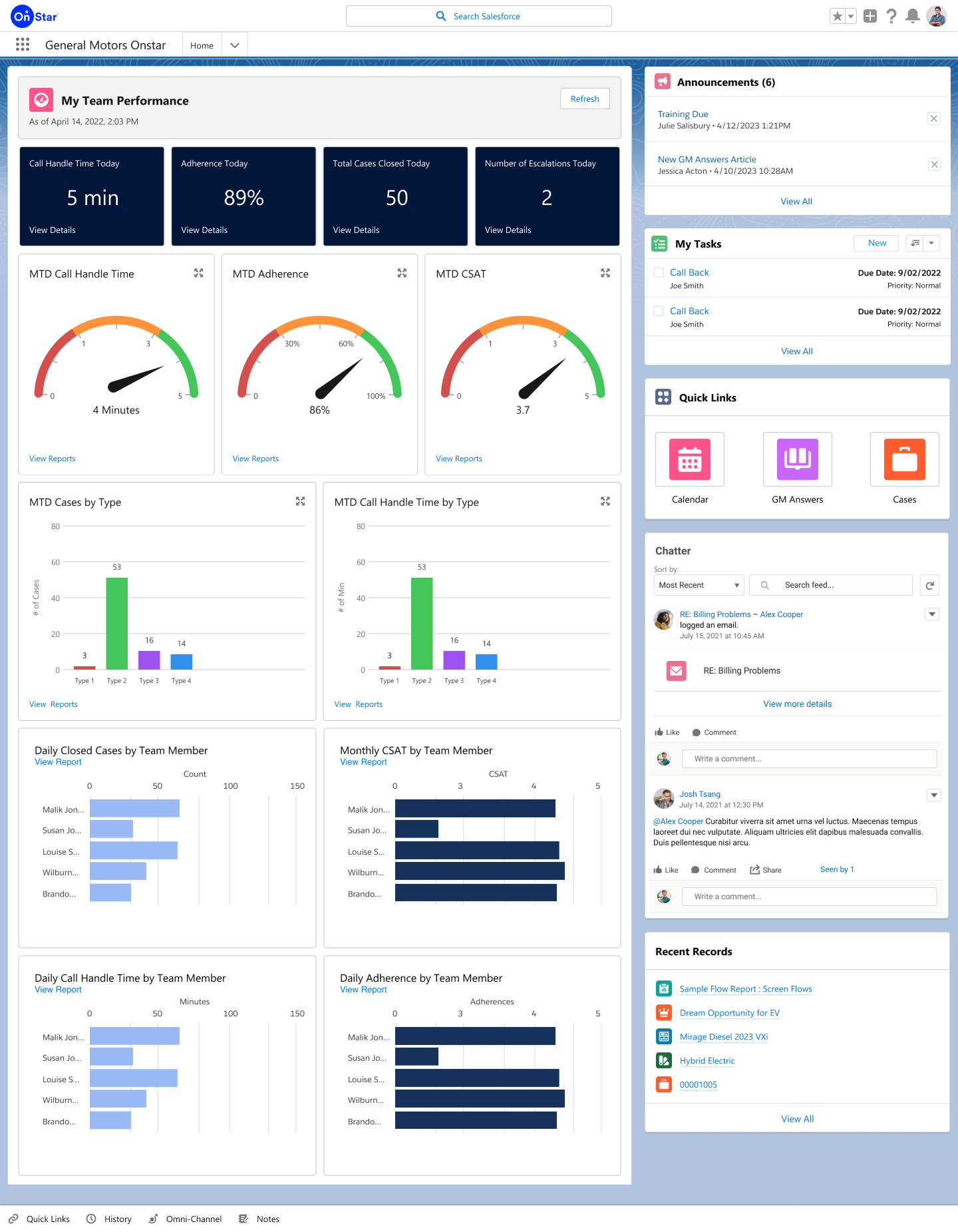
Advisor Dashboard
Empower Me. Integrated Agency
A Role-Based Homepage to transform the start-of-day experience from a state of ambiguity into a state of focus. By engineering a clear starting hub tailored specifically to advisors, supervisors, and specialists, I ensured that the most critical "next steps" are surfaced immediately. This solution reinforces the principle of empowering the frontline through clarity, allowing teams to navigate their day with strategic intent rather than reactive searching.
Strategic Value: A role-based starting hub that surfaces workload, follow-ups, and key actions with total clarity.
The Impact: Transformed the start-of-day from ambiguity to focus, replacing reactive searching with strategic intent.
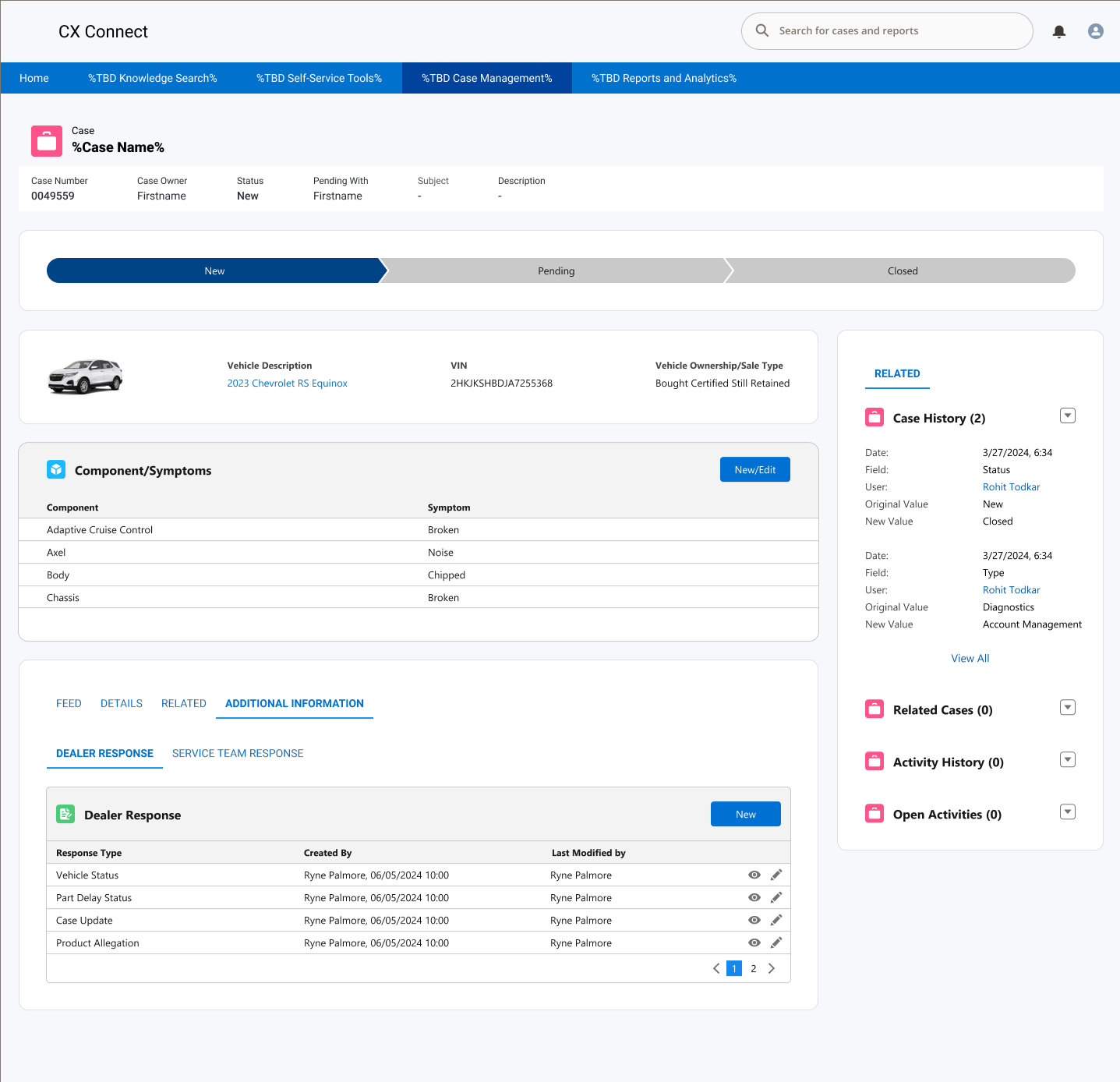
Dealer Portal
Earn My Trust. Radical Transparency.
We built an external resolution experience that extended the platform beyond internal advisors.
Dealers could initiate complex cases with the right context, track downstream ownership, and receive resolution outcomes directly.
This closed the loop back to the frontline, restoring transparency and trust while reducing repeat follow-ups.
Strategic Value: An external resolution experience that allows dealers to track ownership and receive closure in real-time.
The Impact: Erased the "black hole" of dealer updates and restored transparency across the entire service network.
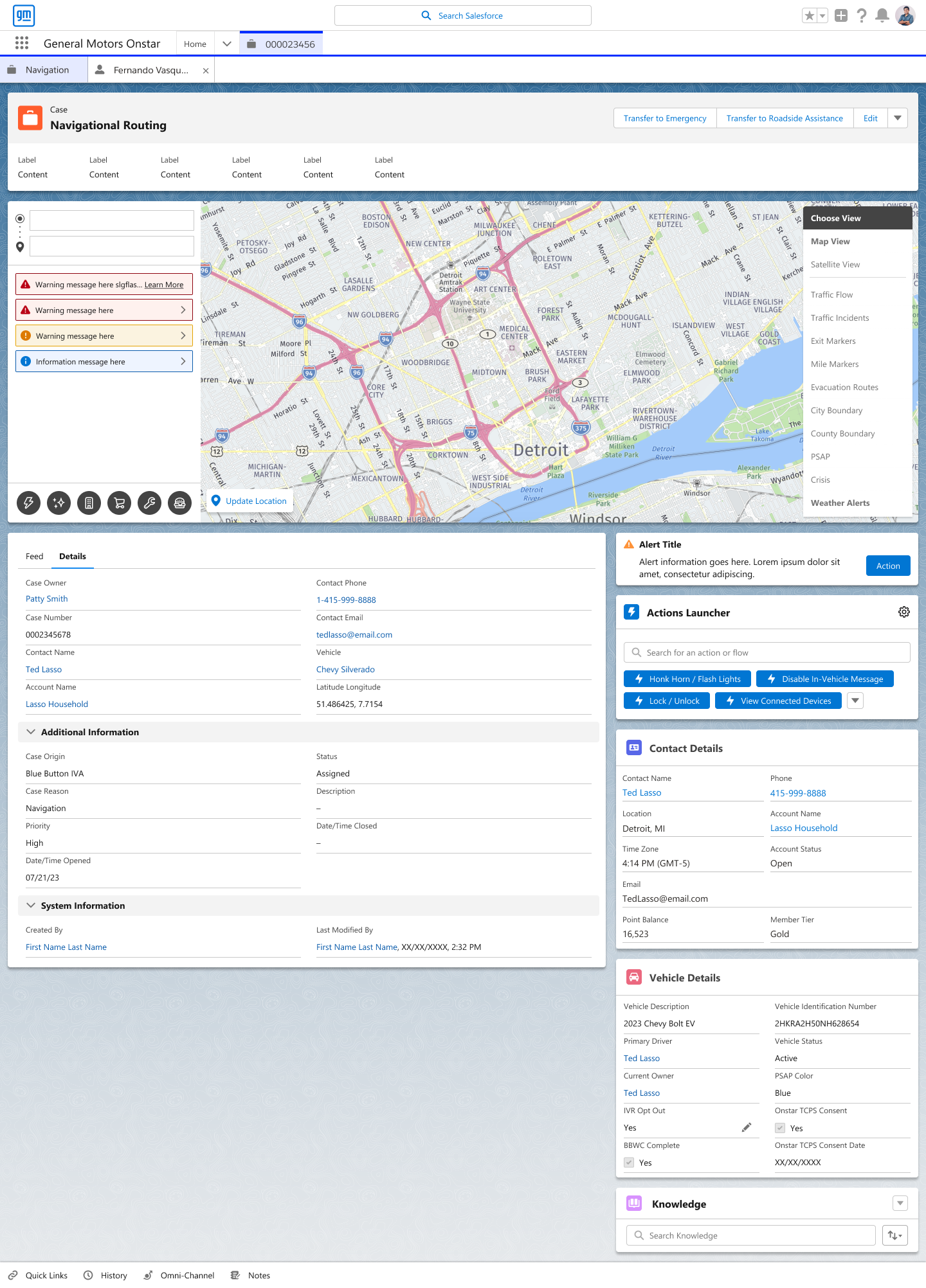
Emergency & Location Services
Bring me joy: Preventive Care.
We designed Context-Aware Emergency Screens to empower agents to act as "calm experts."
Strategic Value: Context-aware screens that automate location intelligence and safety scripts during high-stress crises.
Traffic Alerts
Weather Alerts
Quick Action Launcher for Emergency Services
The Impact: Transformed a high-stress "guessing game" into a structured, reliable life-saving service.
The Impact.
Enterprise Delivery Scale
19,750+ dealer users onboarded since August 11 2025
158,000+ potential users across the network
Peak usage of 7,000+ daily active users
Migrated from legacy DCM with zero operational disruption
180+ features deployed across four Care initiatives
Approximately 7,000 technician cases resolved through the platform
Early dealership data showed:
≥75% improvement in case handling efficiency
Faster resolution through shared visibility
Reduced delays from missed communication
The ≥75% improvement in case handling efficiency was not merely the result of fewer clicks. By adhering to the principle of Zero-Search Awareness, we reduced the "Alt-Tab Tax" and mental fatigue. Advisors were able to resolve cases faster because the system provided the right intelligence at the right time, allowing them to shift from administrative data-hunting to high-value problem solving.
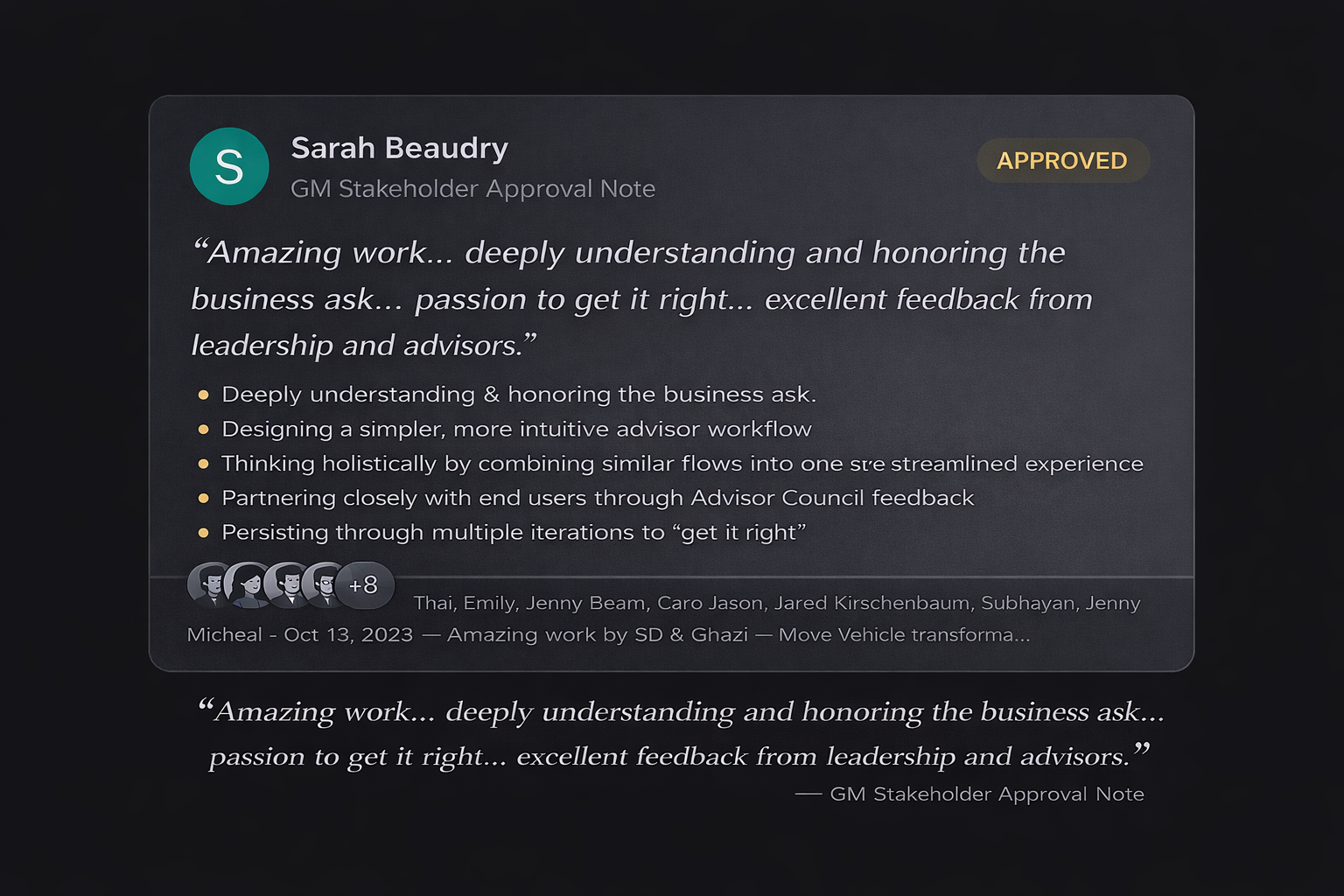
Reflection: “People ignore design that ignores people.”
One of the most meaningful outcomes was the trust built between our team stakeholders, advisors.and dealer end users.
Enterprise UX succeeds when systems are designed not only for efficiency, but for confidence, transparency, and collaboration.
Hearing direct appreciation from frontline dealers reinforced that experience architecture is ultimately about people — even at massive scale.