UX Exercise · 3 Days · AI-Augmented Process
Trading Platform — UX Redesign
What if the way you work with AI matters more than what you use it for?
2–3 Wks → 3 Days
Full UX engagement compressed
The Agentic Team
Roundtable: one design lead, five specialists
The Strategy
Prompt Engineering:
Designed as an operating system
4 HCD Phases
Discover · Analyze · Design · Deliver
The Question
I took this on as a self-directed exercise to pressure test something I'd been thinking about: how much of a full UX engagement can one designer produce in 3 days when using AI as a genuine collaborator, not just for polish, but for the heavy lifting of research synthesis, structural thinking, and production?
I needed a real subject, not a toy problem. A leading comparison platform that helps traders find and evaluate proprietary trading firms. Their key differentiator is a rigorous vetting process, only 6% of firms that apply get approved. Real users, real business model, real design problems.
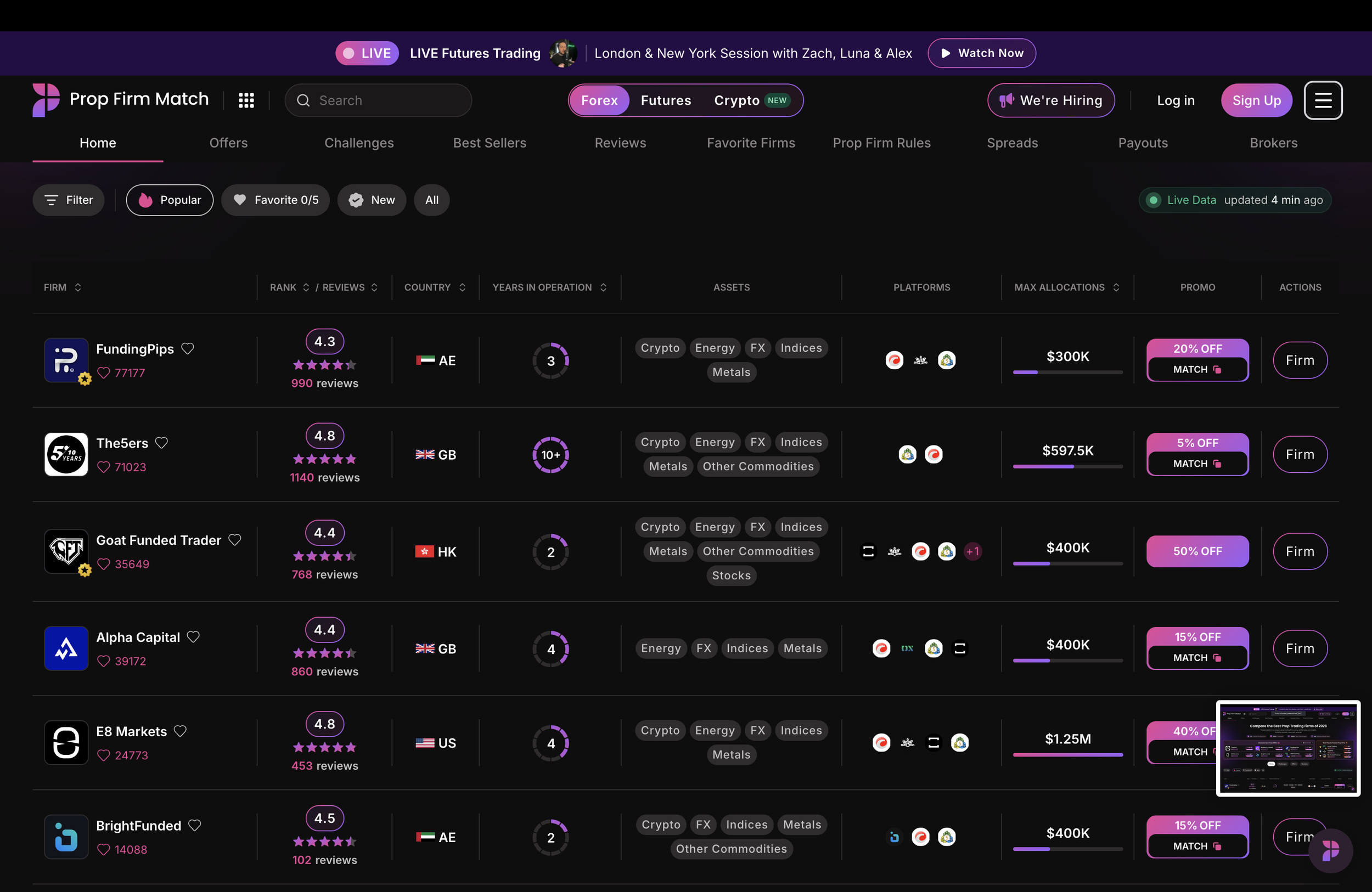
Before: generic comparison table. After: trust-first sequencing that earns the right to each section.
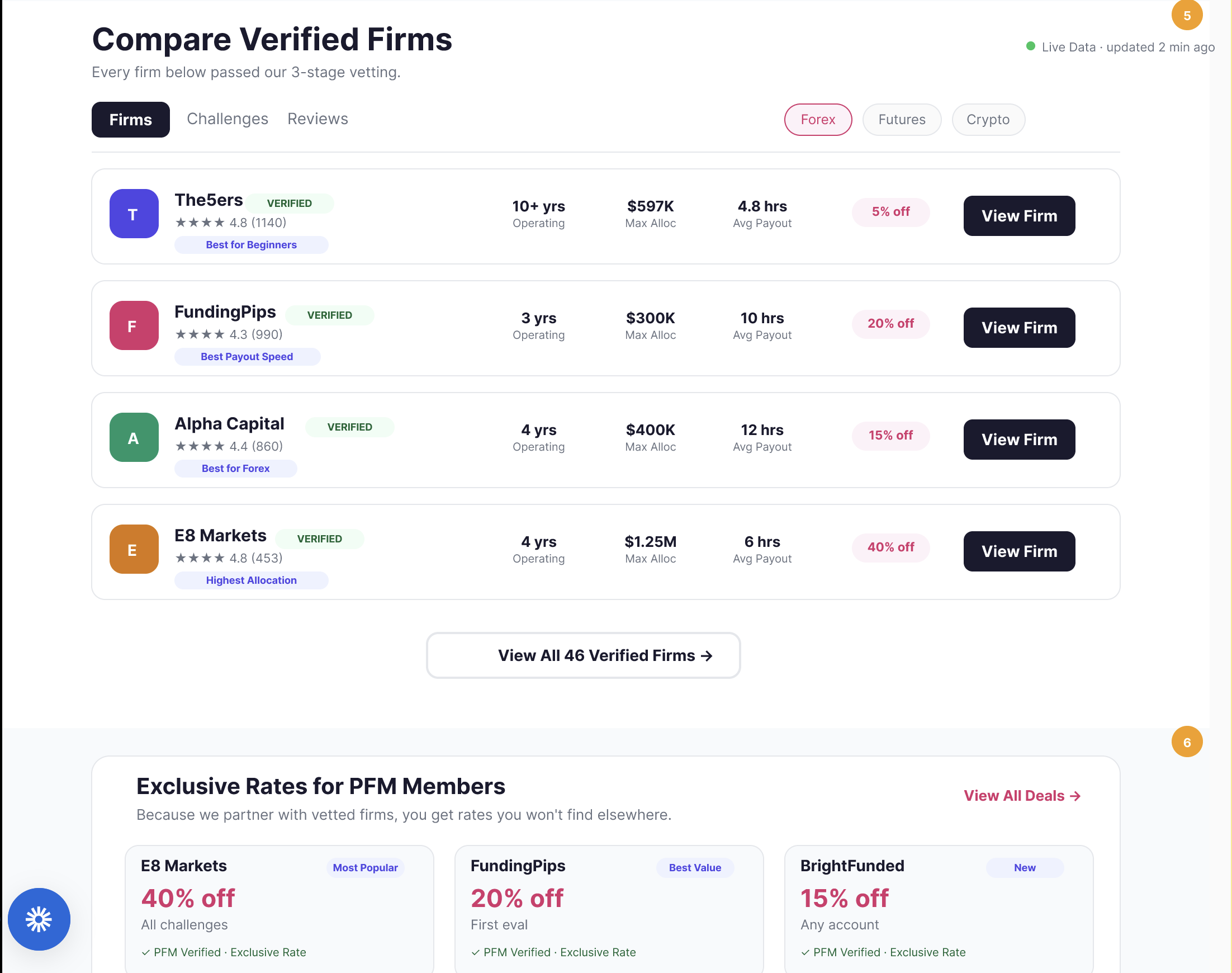
After: trust-first sequencing that earns the right to each section.
The Approach
The question wasn't whether AI could speed things up — it was whether it could do so without sacrificing the process that makes design work defensible.
Not skipping research, not hand-waving personas, not jumping to wireframes. I ran a full Human-Centered Design process across four phases — Discover, Analyze, Design, Deliver — with the rigor I'd expect from a cross-functional team. The 3-day constraint was the stress test; the model itself is how I'd structure any team tackling this kind of problem.
Most people prompt AI the way they'd use a search engine: ask, receive, move on. But design doesn't work that way. Design needs pushback, competing perspectives, and structured tension. So I started with a hypothesis: what if you designed the AI collaboration itself with the same rigor you'd bring to a product? Not a single prompt, but an operating system; roles with distinct lenses, phase gates, accountability mechanisms, built-in disagreement. That hypothesis became a 3,000 word brief, and it changed everything about what the AI produced.
Prompt Design.
The most important design decision in this project wasn't about the homepage It was about how to work with AI in the first place.
Most people use AI like a search engine: ask a question, get an answer, move on. I wanted to test something different. What happens when you design the collaboration itself with the same rigor you'd bring to a product?
Prompt design is design work!
The first thing I built wasn't a wireframe or a research plan, it was the prompt. The 3,000 word operating brief didn't arrive fully formed. Designing it was its own mini exercise: I started with a rough hypothesis about what cross-functional tension I needed, then iterated with AI on role definitions, phase structure, and accountability mechanisms. What started as "give me five perspectives" evolved into a system with handoff protocols, assumption tracking, and built in disagreement. The prompt was the first design deliverable and arguably the highest-leverage one.
My Role:
My role: Design Lead. I set direction, made every final call, and owned the quality bar. The AI proposed. I decided. 24 decisions documented across 3 phases, each logged with my rationale. This wasn't delegation. It was creative direction.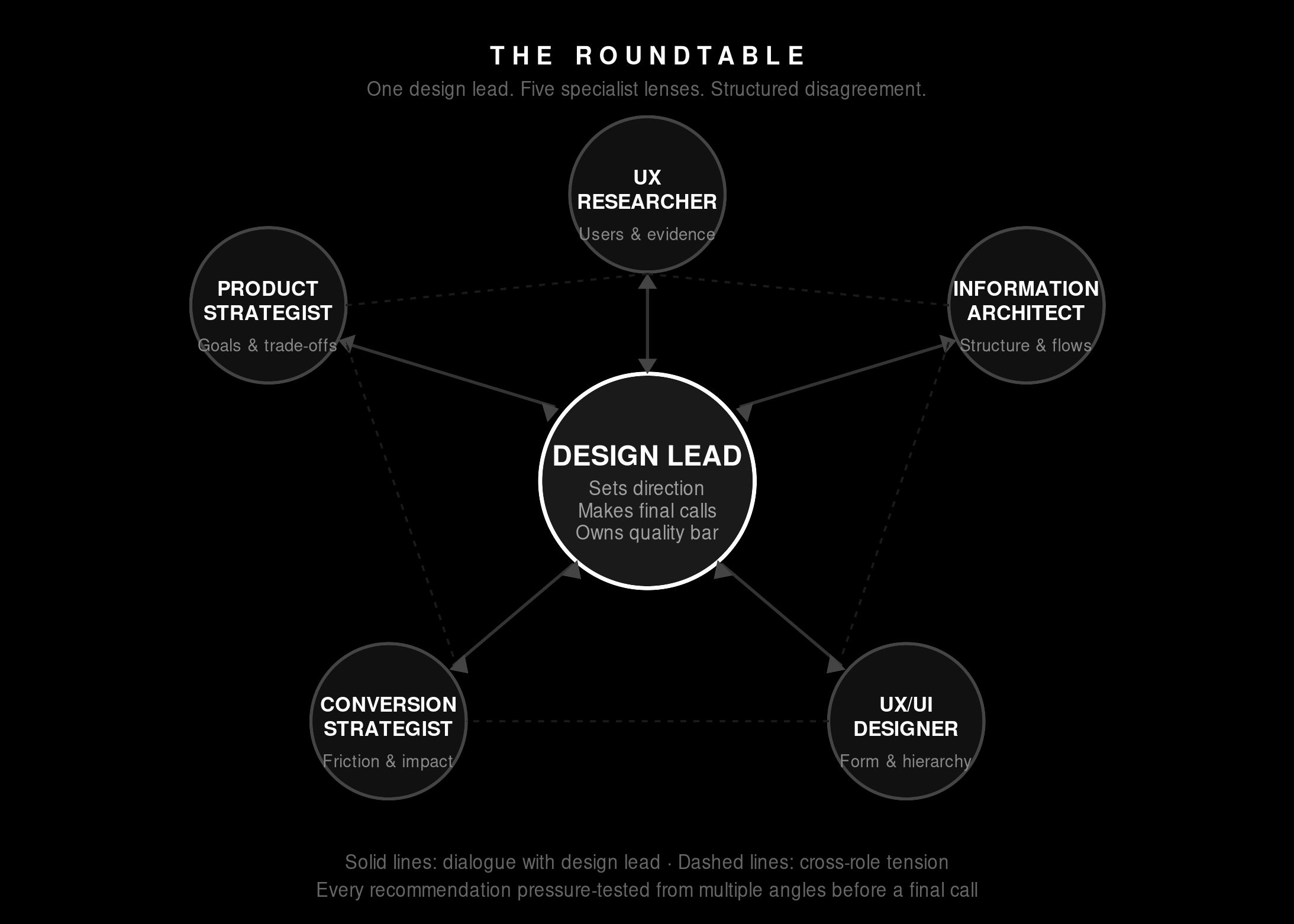
The five specialists:
UX Researcher: User understanding, domain expertise, "what do we know vs. assume?" Information Architect: Structures, flows, navigation, scalability UX/UI Designer: Layout, visual hierarchy, financial-grade aesthetics Conversion Strategist: First-time trader walkthrough, drop-off points, impact quantification Product Strategist: Devil's advocate, business goals, "why this over that?"
Structured disagreement: One design lead. Five specialist lenses.
What surprised me:
the dialogue shaped the outcome.
The trust inversion finding: (the central insight of the entire redesign) didn't come from me issuing a directive. It emerged from the roundtable. The Conversion Strategist flagged that the homepage led with promotions. The UX Researcher connected that to trader psychology. Trust before transaction. The Product Strategist asked why the 6% vetting rate was buried. I was the one who named it "trust inversion" and made the call to restructure around it, but the diagnosis came from the back and forth. No single voice would have gotten there alone.
That pattern repeated throughout: I'd set a direction, the team would pressure test it, someone would raise a tension I hadn't considered, and we'd arrive at something sharper than my original instinct. When I proposed removing promotional discount badges, the Conversion Strategist pushed back, those drive clicks. The resolution wasn't removing them but reframing them as a curation benefit: "we negotiated exclusive rates because we vetted these firms. "That nuance came from the debate, not from a brief.
The operating system behind the collaboration:
The roundtable alone wasn't enough. I needed infrastructure to keep the process rigorous across multiple sessions and phases:
Phase gates with handoff briefs: Each phase ended with decisions, assumptions, and open questions. Each brief included a kick-off prompt for the next session — making the process reproducible, not just documented.
Cross-session context: The project spanned multiple AI conversations. Handoff briefs kept context intact so each session picked up where the last left off, without drift.
Assumption vs. evidence tracking: 8 assumptions flagged with confidence levels and validation plans. When we were guessing, we said so.
Trust Architecture framework: A custom 5-dimension scoring system applied at every phase. Gave the team a shared evaluation lens instead of subjective opinions.
Persona pressure testing: Every opportunity evaluated against both personas. Tensions logged with resolutions, not hand-waved.
AI transparency logging: Tracked what AI generated vs. what I directed throughout, not retroactively. Accountability from day one.
What this means for design teams.
What actually changed?
Yes, AI made this faster — dramatically so. But speed wasn't the revelation. What surprised me was how much it changed the texture of working alone. Design can be isolating. You make a call, move on, and hope your instinct was right. There's no one to push back, no one to say "have you considered this from the trader's perspective?" or "that solves for newbies but alienates your power users."Does speed matter without direction?
Only when it's paired with a point of view. AI without a clear standard produces volume, not value. The operating system I designed kept every output accountable. That's the part that required years of design judgment: knowing what good looks like, knowing which pushback to listen to, and knowing when to override the room.The goal isn't more. It's better.
But the goal isn't to do more projects faster. It's to give designers the thing that's hardest to protect: time to think. The best design decisions don't come from production speed — they come from having space to sit with a problem. AI should buy that space, not fill it with more output.Not a yes-machine. A sounding board.
The roundtable gave me something I didn't expect: a structured set of perspectives that challenged my thinking before it calcified into a wireframe. It stress-tested ideas early, surfaced tensions I would have missed, and forced me to articulate why I was making each call. The work came out more considered — not because AI is smarter, but because I wasn't working in a vacuum.It gets stronger with people.
In a team, this model gets stronger, not redundant. For the individual, AI is a co-pilot — not because you can't fly alone, but because a second perspective on every decision makes the work sharper. For the team, it's a writer's room — when everyone arrives with thinking that's already been challenged, the group conversation starts at a higher altitude.Where it broke down.
AI was weakest where taste and spatial judgment mattered most. Wireframe annotation placement needed multiple rounds of manual correction — AI couldn't "see" when callouts overlapped or when visual hierarchy broke down. The roundtable format occasionally produced consensus where a real team would have had sharper disagreement. And I underestimated how much time I'd spend on quality control — reviewing, redirecting, and rejecting AI output is real work that doesn't show up in the deliverables.The honest takeaway: the most valuable thing I produced in 3 days wasn't a wireframe — it was a way of working that gets sharper with real specialists and scales beyond one designer in a room with AI. Any individual or team can use this model. The skill was never rushing to the answer. It was building a system that adds perspectives, surfaces questions, and challenges your thinking before it becomes a wireframe. Not to slow you down - but to make you more thoughtful, more aware, and more prepared.
The Work
Click through the interactive prototype below to see how that insight became a redesign. It's structured as a 16-slide presentation covering the full process — from personas and competitive audit through to annotated wireframes.The prototype continues past the rationale slides into scrollable, annotated wireframes — desktop and mobile homepage, plus the navigation concept with mega menu states.
Click to go to the next slide in the presentation below.